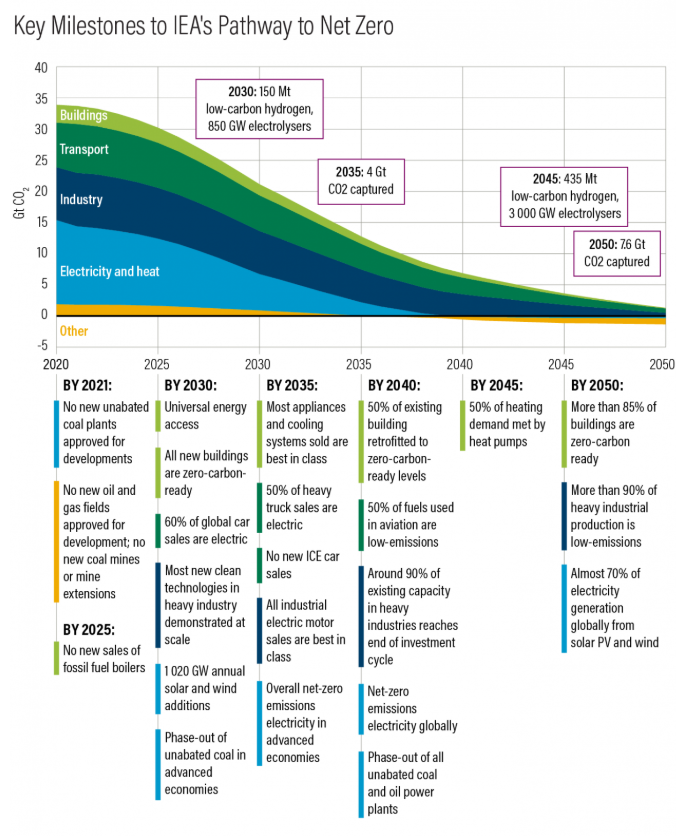
IEAは、「Net Zero by 2050」(2050年までにエネルギー関連の二酸化炭素(CO2)排出をネットゼロにするためのロードマップ)と題した227ページにわたるレポートで、経済を支えるエネルギーシステムを全面的に変革し「太陽光や風力などの再生可能エネルギーを主な動力源とする未来」をめざすことを呼びかけています。8 このレポートは、このような変革のために、今後30年間に必要なステップを明らかにしています。重要なのは、このロードマップが2030年までにエネルギーへの公平なアクセスを実現しながら、経済的にも健康面でも同時に重要な利益をもたらすことです。9
Part III The road to decarbonization – Summary of “Net Zero by 2050” report by the IEA
Week after week, reports of extreme weather events flood the news. The link between these events and climate change is ever more difficult to question, as their occurrence with such frequency is out of norm with natural variation but instead conforms neatly to predictions of model-run scenarios with increased CO2 concentrations.
And still, emissions continue rising at faster rates. According to the UN, around 789 million people worldwide still have no access to electricity. Hundreds of millions more are expected to further augment their current footprint, with the International Energy Agency (IEA) expecting electricity demand to be 2.5 times today’s levels by 2050.1
Given the unprecedented challenge we face and the small window of opportunity to avoid the worse impacts of climate change, scientists have been busy modeling not only the impacts of climate change according to different CO2 concentrations, but also possible emission scenarios that allow for a relatively good chance of staying below 2° C global mean warming throughout the 21st century. These scenarios generally require total greenhouse gas emissions to peak around 2020-2030 and decrease rapidly to global zero around 2070. Variations to this path have different implications, both in regards to the impacts of climate change, and in terms of the mitigation requirements and associated costs down the line.
Since they form the basis of the choices we are presented with and inform policy decisions, it is helpful to understand decarbonization pathways and the options and trade-offs we face. This essay will therefore provide a quick overview of the basics of scenarios and models, and then focus on the IEA’s influential recently released Net-Zero Report, which is said to present the ‘the most technically feasible, cost-effective and socially acceptable’ path towards decarbonization.
As countries and companies join the current trend and adopt net-zero targets, what follows also touches upon what this might mean – and there’s both cause for concern and for optimism. In brief, the bad news is that many net-zero pledges rely on carbon offsets from forestry and natural ecosystems, which are at best temporary, or on carbon removal technologies, which are still unproven at scale. The good news is that the potential for renewables and breakthrough technologies has thus far consistently surpassed models’ assumptions, the growth of solar blowing past even the most hopeful forecasts. 2 So while we should be cautious and ready to call out the difference between realistic decarbonization plans and mere rhetoric, we can be forgiven for believing the clean energy revolution is here to stay.
Decarbonization scenarios
Decarbonization scenarios are drawn from so-called Integrated assessment models. These models aim to capture the linkages between economic decisions and development and the natural system under climate change. The term is used to describe a large variety of models, from the rather simple to the incredibly complex. In general, they all use different combinations of societal trends, energy use options, technologies and other factors determining greenhouse gas emissions to see their effect on the climate system. The most important variations in the modelled scenarios have to do with the time of peak emission, the point in time at which emissions reach net zero, and their reliance of carbon removal and other technologies.
While the degree of uncertainty when modeling the climate system can be considerable, insofar as it draws on certain natural principles and laws it is somewhat straightforward. In contrast, human systems models start with a long list of assumptions about how the world works and how populations and societies will change. These assumptions include population increase, baseline economic growth, resource availability, technological change, and the mitigation policy environment – which in turn require all kinds of assumptions about social behavior, and depend on changing and unknowable forces, such as habits, social values, political shocks, or disruptive innovation. In fact, models are most useful for asking “what if” questions insofar as they can trace feedback and tradeoffs between different interacting components.
The best-known scenarios are those used by the Intergovernmental Panel on Climate Change (IPCC). In its 2018 Special Report on 1.5° C, the IPCC concluded that even from current emission levels, pathways that allow for keeping warming at 1.5° C or below 2° C by the end of the century are extremely challenging but still technically feasible.3
However, with every decade lost, the challenges and costs rise. A slow start in emission reductions needs to be followed by faster reductions later on, with concomitant higher costs for the period 2030–2050. 4 A later peak in emissions peak requires correspondingly more negative emissions to compensate.
To remove CO2 from the atmosphere, models often rely on bioenergy and carbon capture and storage to provide the required negative emissions. The scale of the deployment of these largely unproven technologies is huge. Some model pathways allocate as much as five times the area of India to growing the biomass needed by 2100 5 ; others require a quarter of global agricultural land. Given food production needs, land tenure issues and climate change impacts, it’s clearly not going to happen.
Yet it is not the details but the areas of broad agreement among different models that is most telling: the fact that emissions have to peak and then decline rapidly to net-zero; that negative emissions of some sort are likely to be needed, with their scale and nature depending on related choices; and that the global energy system must be increasingly electrified, sourced
by renewables.6 Models also agree that with the current emission reduction pledges by countries under the Paris Agreement, there is no way we can stay below 2º C of warming, and that for every year of delay, the impacts become more difficult to avoid.7
Enter the IEA
In a 227-page report titled “Net-zero by 2050: A roadmap for the global energy sector,” the IEA calls for a total transformation of the energy systems that underpin our economies towards a future “powered predominantly by renewable energy like solar and wind.”8 The report goes to identify the steps necessary in the next thirty years for such a transformation. Importantly, the roadmap arrives there while simultaneously achieving equitable energy access by 2030 and delivering key economic and health benefits.9
In the IEA net-zero scenario, renewable energy would overtake coal by 2026 (four years from now), and pass oil and gas before 2030 (in only eight years). By 2050, it should go on to meet two-thirds of global energy supply and nearly 90 percent of electricity generation.10 This switch to renewables must be complemented by an electrification process in other sectors such as transportation, buildings and industry to take advantage of the new renewables.
For this to happen, the solar and wind capacity added in 2030 should be more than triple the amount installed in 2020. While this may sound daunting, solar and wind capacity already more than tripled between 2010 and 2020 - and many developing countries are only now starting to scale up to their renewable energy potential.11
The IEA report includes 400 milestones; some of the key goalposts in the scenario include the following:
• This year, 2021, nations would stop approving the development of new oil and gas fields beyond those already committed, as well as any new coal plants unless they include carbon capture technology to trap and bury their emissions underground.
• By 2025, the sale of new oil and gas furnaces to heat buildings would be banned worldwide, to be replaced by cleaner electric heat pumps.
• By 2030, electric vehicles would account for 60 percent of new car sales globally (up from just 5 percent today). By 2035, new gasoline- or diesel-fueled passenger vehicles would no longer be sold, and by 2050, virtually all cars on the roads worldwide would either run on batteries or hydrogen.
• By 2035, the world’s advanced economies would zero out emissions from power plants and shift to technologies like wind, solar, nuclear and low-carbon hydrogen, or use carbon capture. By 2040, all of the world’s remaining coal-fired power plants would be closed or retrofitted with carbon capture technology.
• By 2035, more than half of new heavy trucks would also be electric. By 2040, cleaner alternatives to jet fuel, such as sustainable biofuels or hydrogen, would power roughly half of all air travel worldwide.
The changes can be started with technologies available today, such as wind and solar energy and electric vehicles. Yet by 2050, new technologies now in development - such as advanced batteries, cleaner hydrogen fuels for steel plants, and devices to pull carbon dioxide out of the atmosphere - would have to account for around half of the emission cuts.
Clearly this is a massive change and it needs to start in earnest this year already. It requires investment in clean energy and energy infrastructure to triple by 2030, as well as a major push in research and development programs and tighter global cooperation.
It also doesn’t come without challenges, particularly those relating to sourcing critical metals, labor force transitions and shifts in geopolitical power.
The good news is that in slashing CO2 emissions and switching to renewable energy many millions more jobs are created than lost.12 The process is estimated by the IEA to be able to lift global GDP growth by 0.4 percent a year over the course of this decade, and 4 percent higher than it would be based on current trends by 2030. Otherwise, given the impacts of climate change, failure to limit warming to 1.5º to 2º C could cost around 10 percent of global GDP by 2050.13 The benefits of a new climate economy – in terms of new jobs, economic savings, competitiveness and market opportunities, as well as improved well-being for people worldwide – are real. And it is technically and economically feasible. There just isn’t much margin for error or delay.
Model limitations
One fundamental problem with scenarios is that data collection and scenario building take time, so scenarios typically rely on data that is behind in terms of real-world developments. This was particularly a problem when including renewables, as the energy transition is happening at a faster than expected rate. The rapid declines in the cost of solar, wind, and lithium-ion batteries have been a challenge to include, as models tend to assume linear growth.
Conversely, models are problematic for their extremely optimistic projections of the use of capture and storage and related carbon removal technologies such as bioenergy, which they tend to rely on heavily partly because they assume “discounting” – assuming near-term costs are higher than those in the future. But the real world is quite unlike the rational, least-cost world of a model. Indeed, another limitation of models is their lack of political constraints. Moreover, because they assume existing societal trends, as if habits and relationships remain the same in the future as in the past, they are unable to forecast shocks or innovations, from the oil crises of the 1970s and global conflicts through to the rise of computers, mobiles and the internet.14
Perhaps more significantly, most models don’t measure economic damages and reduced growth due to climate change, such as flood losses or adaptation costs due to rising sea levels, thus missing the cost of inaction and the potential co-benefits of action.
The problem with some Net-zero pledges
While generally welcome, the current trend to proclaim net-zero carbon targets by mid-century has come under scrutiny, particularly when the plan assumes offsets from forests and carbon-absorbing ecosystems.15 This is because forests are widely expected to turn from a sink of carbon to a source of carbon at some point in this century, affected by rising temperatures as well as pests and fire resulting from climate change. Moreover, natural carbon uptake by forests and ecosystems is already included in the models and decarbonization scenarios, so to assume that current emissions can be compensated for by including these reservoirs amounts to little more than an accounting trick, one that will be all too evident at the final tall16
Protecting and enhancing natural ecosystems is important for all kinds of good reasons, but to assume they will take care of current emissions is a dangerous proposition. Some calculations of the scale at which trees would have to be planted is nonsensical: the oil and gas giant Shell, for example, has committed to net-zero by 2050, while anticipating a 20 percent increase in gas production by 2030. To achieve net-zero, Shell expects to offset its emissions through forest projects, which some analysts calculate would require a forest the size of Brazil.17
It is clear that offsetting with nature-based solutions should be done in addition to reducing emissions, not instead. Improving on techniques for carbon dioxide removal is necessary, but should be used to offset residual, difficult to address emissions in sectors like agriculture and aviation.
Still, in spite of attempts at whitewashing and delaying action, many believe the clean energy revolution will be unstoppable. It better be so, because otherwise the worse impacts of climate change will soon also be unstoppable.
María Gutiérrez, Ph.D.
Consultant
International Institute for Sustainable Development (IISD)
United Nations Framework Convention on Climate Change (UNFCCC)
6 温暖化が1.5℃でも2℃であっても排出経路は似ていて、2℃の場合は1.5℃の場合よりもわずかに緩やかで、ネガティブ・エミッションの利用もわずかに少なくなる可能性があります。その違いは、対策が遅れた分気候変動によるインパクトが大きくなり、また対応すべき問題が増えるのです。The path is similar for the 1.5o C and 2o C limits: a soon peak and then rapid decline, just slightly more gradual and with possibly slightly lowered use of negative emissions for 2o C than for 1.5o C. The difference there is the added challenges posed by impacts from climate change itself with delayed action.
8 https://www.iea.org/reports/net-zero-by-2050. IEAは以前から保守的な団体とされ、再生エネルギーの重要性や成長性を軽視することが多くありました(IEAは1970年代の石油ショックに対応して「石油供の安全性を確保する」ために設立されました)。IEAは今回のレポートで、新規油田・ガス田の開発を世界的に即時停止することを求めており、ネット・ゼロ戦略を推進する一方で、油田開発し続けている石油大手会社と対立していますThe IEA has long been seen as a conservative body, and it often downplayed the importance and growth in renewables (it was formed in response to the oil-supply shocks of the 1970s to “ensure the security of oil supplies”). By calling on an immediate worldwide end to approvals of new oil and gas fields, the report places the IEA “at odds with oil giants that are promoting corporate net-zero strategies while continuing to search for more oil.” See: : https://yaleclimateconnections.org/2021/06/key-readings-on-ieas-net-zero-by-2050-report/.
9 IEAの開発ニーズにおけるネット・ゼロシナリオのファクターは、2030年までにユニバーサルな電力アクセスが実現することが重要であり、これは1.5º Cの温暖化に向けたあらゆる(排出)経路がこの要因を含んでいるわけではないからです。The IEA’s net-zero scenario factors in development needs and achieves universal electricity access by 2030, which is important because not all 1.5º C-compatible pathways include this.
11 IEAは、再生エネルギーの発電コストが低下しているにもかかわらず、その可能性を過小評価していると指摘する声もあります。特に太陽光発電については、過去10年間発電とバッテリーのコストは実際に年率18%で低下していますが、IEAは今後10年間のコスト低下率を5%、2030年以降は2%と想定しています。 Some observers find that the IEA still underestimates the potential of renewables given their reduced costs – especially for solar: while solar and battery costs have been falling at 18 percent a year for the last decade, the IEA assumes a rate of fall of cost of 5 percent over the next decade, and then to 2 percent after 2030). See: :https://reneweconomy.com.au/is-the-iea-still-underestimating-the-growth-of-renewable-energy/
12 IEAとIMF(国際通貨基金)によると、太陽光発電、建築物の効率化、都市交通インフラに100万米ドルを投資するごとに、ガスや石炭に同額を投資した場合の2倍以上の雇用が創出されるといいます。According to the IEA and the International Monetary Fund, each USD $1 million invested in solar photovoltaics, building efficiency or urban transport infrastructure creates more than twice as many jobs as the same amount invested in gas or coal.See: https://www.wri.org/insights/5-things-know-about-ieas-roadmap-net-zero-2050
14経済学的なことをもとにして意思決定するのであれば、これらのモデルは十分に機能し、競争力のある市場で、合理的な参加者たちがいることを前提としています。しかし、ケンブリッジ・エコノメトリックスのヘクター・ポリット氏は、自動車について次のように述べています。「もし誰もがコストの最適化を意識するなら、みんなスマートカーに乗っているはずですが、実際には高急なモデルの車を購入しているのです」と述べています。 (以下リンク先より引用: In using economics as the basis for decision making, models assume fully functioning markets and competitive market behavior as well as rational actors. But as Hector Pollitt, from Cambridge Econometrics, says about cars, “If everyone was cost-optimizing, we’d all be driving Smart cars. But it’s pretty much the opposite of that: many people buy the most expensive model they can” (quoted in: https://www.carbonbrief.org/qa-how-integrated-assessment-models-are-used-to-study-climate-change).
16 チャタムハウス(英 王立国際問題研究所)のロブ・ベイリー氏は「そもそも、1トンのCO2を排出しない方が、コストやどのくらいの期間、どこでといった不確かな要素ばかりでどんな結果になるかわからないまま、CO2をどれだけ削減できるかと期待しながら排出し続けているよりも、明らかにリスクが少ない」とみています。As Rob Bailey, from Chatham House put it, “It is clearly less risky not to emit a tonne of CO2 in the first place, than to emit one in expectation of being able to sequester it for an unknown period of time, at unknown cost, with unknown consequences, at an unknown date and place in the future.” See: : https://www.carbonbrief.org/in-depth-experts-assess-the-feasibility-of-negative-emissions#bailey