One of the many changes that the year 2020 seems to have brought with it is a heightened sense of urgency on the need to address climate change. This sense has carried on to 2021, prodded further by various high-level announcements and events, including US President Biden’s Leaders Summit on Climate; official commitments to move towards decarbonization with specific near-term and mid-century targets by the world’s major economies, notably China; and the release of the International Energy Agency’s (IEA) report calling for net-zero emissions by 2050 with a plausible scenario for achieving it. While it was well understood that the 2020-2030 decade was critical for action to stave off the worse impacts of climate change, the current momentum provides some hope that the world’s energy transition might have finally started to shift gears.
Perhaps because it’s easier to imagine and enact change after an upheaval rather than in the midst of routine, and largely thanks to growing social mobilization in this regard – especially by youth –, climate change has received more substantial attention at higher levels of government these past few months than ever. Countries that represent 73 per cent of emissions have committed to net zero by mid-century, and thousands of large multinational companies and financial sector firms, as well as cities worldwide, have set emissions-reduction targets and are partnering in mitigation efforts. 1 More surprisingly, a landmark court decision in The Hague requiring Royal Dutch Shell oil company to sharply cut greenhouse gas emissions from all its global operations this decade, as well as separate boardroom challenges to a continuation of business-as-usual at Exxon Mobile and Chevron, were deemed by many observers to represent a turning point in the climate change battle - a sign that lack of climate action is becoming a financial risk as well as an environmental one. 2
And yet, under policies in place today, the world is headed for a disastrous 2.9° C of warming by 2100 relative to pre-industrial levels3 – an increase that would render large parts of the planet uninhabitable and result in mass extinctions of species. Even if countries meet their current Paris Agreement pledges and targets in full – a big IF –, temperatures would rise 2.4° C.4
One only has to look at the numbers – of climate change-related impacts, of emission trends, of estimated carbon budgets – to understand the gravity of the situation. Clearly the feeling that something has to be done is happening not a moment too soon.
This essay takes over from the previous blog entries by Tokyo University’s Junya Tani but focuses specifically on climate change. In four instalments, it will revisit key scientific findings and provide an overview of the concepts that shape the international discussion, such as the 1.5° and 2º C temperature increase limits, decarbonization goals and the scenarios for achieving them. It will then highlight important milestones marking 2020 and 2021 as momentous years for action in the context of the international climate change regime, and touch upon what lies ahead now that the pace and pressure for more sustainable growth seems to have, hopefully, finally started to pick up.
The rise of emissions
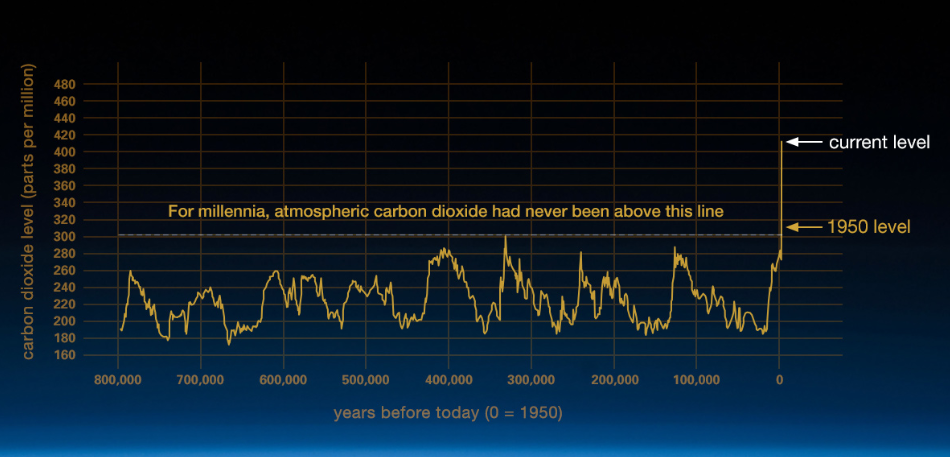
At an annual average of 417 parts per million (ppm)5, carbon dioxide (CO₂) levels today are higher than at any point in at least the past 800,000 years. It is said, in fact, that the last time that atmospheric CO₂ amounts were this high was more than 3 million years ago, when temperature was 2°– 3° C higher than during the pre-industrial era, and sea level was 15–25 meters higher than it is today.6
While the origin of this change is well known, traced to the beginning of the Industrial Revolution in the late eighteenth century, it is the pace of the change that is most worrisome. CO2 emissions from the burning of fossil fuels rose slowly at first, but then started escalating at a dizzying rate: in 1776 (the first year Watt’s steam engine was marketed), humans emitted some 15 million tons of CO2; in 1800, just 24 years later, the figure had doubled to 30 million tons; fifty years later, in 1850, it was 200 million tons a year - almost seven times higher; and by 1900 emissions had reached almost two billion tons. Today the figure is close to 40 billion tons per year.7 This increase in human-induced CO2 is more than 250 times faster than that from natural sources after the last Ice Age, 11,000-17,000 years ago.
[NASA graph on CO2 concentrations going back to 800,000 years ago]
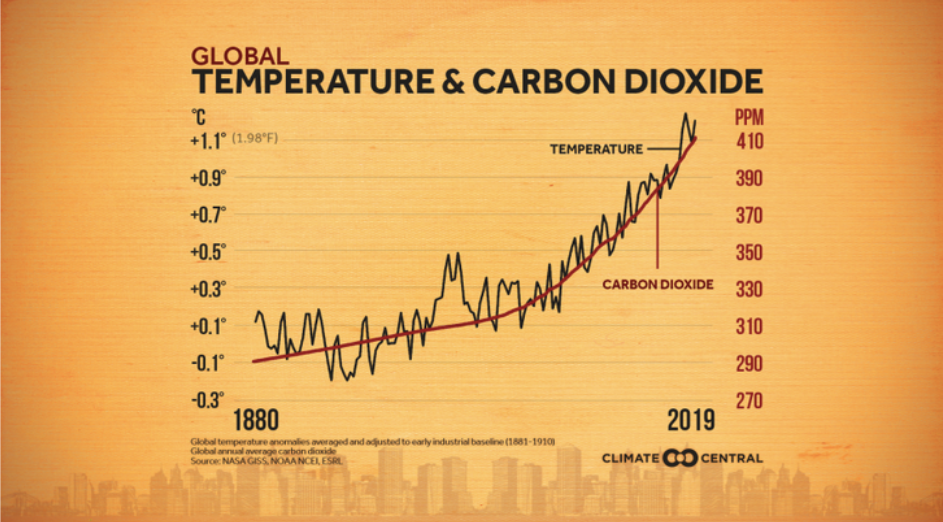
This recent steep rise in CO2 shows a remarkably constant relationship with fossil-fuel burning. As stated by NASA, this correlation can be well accounted for based on the simple premise that about 60 percent of fossil-fuel emissions stay in the air.8 Since CO2 and related gases act as a shield in the atmosphere, guarding heat under them like a greenhouse roof, the rise in CO2 concentrations in turn matches the observed increase in the earth’s global temperatures since the late eighteen-hundreds.
[Parallel between emissions and temperature rise]:
Source: Climate Central( Global Temperatures and CO2 Concentrations (2020) | Climate Central)
To this day, CO2 concentrations have continued to rise – even last year when emissions fell sharply due to the COVID-19 global pandemic to levels last seen 15 years ago. In April 2020, for example, at the peak of the pandemic, regions responsible for ca. 90% of global fossil CO2 emissions were under some level of confinement; aviation activity decreased by 75%, surface transport by 50%, power generation by 15%, and industry around ~35%; only in the residential sector did activity increase by 5%.9
Yet this dramatic worldwide economic shutdown had no detectable impact on atmospheric CO2 or climate change; it simply resulted in a slower rate of increase. In a commonly used simile, the rise in CO2 concentrations is akin to a bathtub with the water tap running: even if we decrease the water pressure, it is still accumulating and will eventually overflow. And this slower increase in emissions of the past year and a half is expected to be quickly offset as economic activity rebounds.
1.5° and 2° C: The difference half a degree can make
The concentration of all that CO2 and other greenhouse gases in the atmosphere has already led to a rise in global average temperatures since pre-industrial times of 1.1° - 1.2° C. For a long time, since the adoption of the United Nations Framework Convention on Climate Change (UNFCCC) in 1992, it was agreed that, to stay within somewhat safe levels, the rise should be limited to maximum 2° C relative to pre-industrial levels. This was written as the ultimate objective of the Climate Change Convention - that is, to “prevent dangerous anthropogenic interference with the climate system.”
But with improvements in our understanding and evidence of the impacts of global warming, “dangerous interference with the climate system” was soon found to occur already at a temperature increase of 1.5° C, especially in low-lying areas, vulnerable regions and the oceans.
In a well-fought negotiation battle at the end of the 21st Conference of the Parties to the UNFCCC when the Paris Agreement was adopted in 2015 (COP-21), the Small island developing states and the Least developed countries groups managed to include reference in the text to the 1.5° C target.10 As a result, the Paris Agreement’s long term temperature goal is set as “holding the increase in the global average temperature to well below 2° C above pre-industrial levels and pursuing efforts to limit the temperature increase to 1.5° C above pre-industrial levels.”11
The Intergovernmental Panel on Climate Change (IPCC), the leading international body for the assessment of worldwide scientific climate change research, was then asked to look into the 1.5˚ and 2˚ C goals - their impacts and options to limit and/or deal with such warming. 12 In a special report released in 2018, the IPCC concluded that the world will face severe climate impacts already with 1.5° C of warming, but the effects get worse, often significantly so, with 2° C degrees.
For example, the IPCC finds that with a warming of 1.5° C, about 21-37% of the Arctic’s permafrost would thaw by 2100; this goes up to ca. 47% at 2° C - an area of land that is three-quarters the size of Australia.13 Under 1.5° C the world is very likely to have one sea-ice-free summer every 100 years, but the frequency increases to at least one every 10 years at 2° C – that is, it’s ten times worse. 14 This can in turn lead to more heat being absorbed and to impacts on ocean circulation, with consequences for winter weather in the Northern hemisphere.
In land, the percentage of plants and vertebrates that will see their geographic range reduced by more than half will be twice as large under 2° C, and three times worse for insects. This has consequences not only for the species affected, but for whole ecosystems: think for instance of the role of pollinating insects in supporting terrestrial productivity, including human food production systems.
Even more poignant is the impact on oceans: coral reefs are expected to decline by 70 - 90% already at a warming beyond 1.5° C. If this sounds dreadful, know that his turns into a 99% loss at 2° C of warming. Acidification, dead zones and other dangerous conditions are also projected to be more pronounced with warming higher than 1.5° C.
The impacts increase significantly also for human populations: the amount of people exposed to severe heat at least once every five years goes from 14% to 37% with that half a degree more of warming. At 2° C warming, the deadly heatwaves that India and Pakistan saw in 2015 may occur annually. Impacts similarly increase in terms of areas exposed to severe drought and people exposed to climate change-induced water stress.
The degree of these risks depends on many factors, such as the rate, duration and magnitude of warming; levels of development and vulnerability; and possible adaptation options. However, in every case, the impacts will hit the poor and most vulnerable the hardest given the loss of livelihoods, food insecurity, population displacement, health effects and more. Some regions will experience multiple climate-related risks that compound upon each other.
It is important to keep in mind that these are global averages: a global temperature rise of 2° C degrees may mean 1.8° C degrees in Denmark, but possibly 4° C in central Africa. If it’s a global warming of 3° C, the rise could reach 7° C in some parts of the world, leading to a cascade of other effects and tipping points.
But it’s the speed of temperature change that’s most damaging. As climate scientist Michael Mann says, “the real issue, from a climate change impacts point of view, is the rate of change - because that’s what challenges our adaptive capacity.” 15 Our planet’s living systems have evolved over thousands of years in relatively stable temperature ranges, so most would not be able to evolve quickly enough to accommodate rapid changes and would therefore be driven to extinction. And as we have learned, the current rate has no precedent as far back as we can see, or at least 11,000 years – more or less when humans started to settle and grow in the planet.
María Gutiérrez, Ph.D.
Consultant
International Institute for Sustainable Development (IISD)
United Nations Framework Convention on Climate Change (UNFCCC)
The commitment to 100% renewable energy by companies under RE100 for example has created a demand for renewable electricity amongst its members bigger than that of a G7 country, with companies together consuming more electricity than Australia.
[3] これはCarbon Action Trackerによる最新の計算値ですが、楽観的な見方をする人もいます。UNEPの「排出ギャップ報告書2020」では、3.2℃とされています。This is the most recent calculation according to Carbon Action Tracker, but is considered optimistic by some. The UNEP Emissions Gap Report 2020 puts it at 3.2° C (URL: https://www.unep.org/emissions-gap-report-2020)
米国や中国、その他の国々が発表あるいは検討しているもののUNFCCCには未提出のネット・ゼロ目標を完全に実施するという、いわゆる「楽観的目標」シナリオでは、2100年までの地球温暖化が2.0℃にとどまる可能性があります。残念ながら明確かつ意欲的な目先の政策なしに、ネット・ゼロ目標を今世紀半ばに達成することは非常に難しいと考えられます。Note that under a so-called “Optimistic Targets’ scenario” based on full implementation of the net zero targets announced or being considering by the US, China and other countries, but not yet submitted to the UNFCCC, global warming by 2100 could remain at 2.0° C. Unfortunately, reaching these net-zero targets in mid-century without clear and ambitious near-term policies is deemed highly unlikely.
[10]2010年に合意されたUNFCCCカンクン合意(COP16)以降、温暖化を1.5℃に抑制することを求めていた小島嶼開発途上国の国々。Small island developing states and had been calling for limiting warming to 1.5 since the UNFCCC Cancun Accords, agreed in 2010.